Love Test!

I remember the story: John Blanchard stood up from the bench, straightened his Army uniform, and studied the crowd of people making their way through Grand Central Station. He looked for the girl whose heart he knew, but whose face he didn't, the girl with the rose. His interest in her had begun thirteen months before in a Florida library. Taking a book off the shelf he found himself intrigued, not with the words of the book, but with the notes penciled in the margin. The soft handwriting reflected a thoughtful soul and insightful mind.


In the front of the book, he discovered the previous owner's name, Miss Holly Maynell. With time and effort he located her address. She lived in New York City. He wrote her a letter introducing himself and inviting her to correspond.

The next day he was shipped overseas for service in World War II. During the next year and one month, the two grew to know each other through the mail. Each letter was a seed falling on a fertile heart. A romance was budding. Blanchard requested a photograph, but she refused. She felt that if he really cared, it wouldn't matter what she looked like

When the day finally came for him to return from Europe, they scheduled their first meeting - 7.00 p.m. at the Grand Central Station in New York.


"You'll recognize me," she wrote, "by the red rose I'll be wearing on my lapel." So at 7.00 p.m. he was in the station looking for a girl whose heart he loved, but whose face he'd never seen. I'll let Mr. Blanchard tell you what happened:


A young woman was coming toward me, her figure long and slim. Her blonde hair lay back in curls from her delicate ears; her eyes were blue as flowers. Her lips and chin had a gentle firmness, and in her pale green suit she was like springtime come alive. I started toward her, entirely forgetting to notice that she was not wearing a rose. As I moved, a small provocative smile curved her lips. "Going my way, sailor?" she murmured.


Almost uncontrollably, I made one step closer to her, and then I saw Holly Maynell. She was standing almost directly behind the girl. A woman well past 40, she had graying hair tucked under a worn hat. She was more than plump, her thick-ankled feet thrust into low-heeled shoes. The girl in the green suit was walking quickly away. I felt as though I was split in two, so keen was my desire to follow her, and yet so deep was my longing for the woman whose spirit had truly companioned me and upheld my own.


And there she stood. Her pale, plump face was gentle and sensible, her gray eyes had a warm and kindly twinkle. I did not hesitate. My fingers gripped the small worn blue leather copy of the book that was to identify me to her.


This would not be love, but it would be something precious, something perhaps even better than love, a friendship for which I had been and must ever by grateful. I squared my shoulders and saluted and held out the book to the woman, even though while I spoke I felt choked by the bitterness of my disappointment. "I'm Lieutenant John Blanchard, and you must be Miss Maynell. I am so glad you could meet me; may I take you to dinner?" The woman's face broadened into a tolerant smile. "I don't know what this is about, son," she answered, "but the young lady in the green suit who just went by, she begged me to wear this rose on my coat. And she said if you were to ask me out to dinner, I should tell you that she is waiting for you in the big restaurant across the street. She said it was some kind of test!"
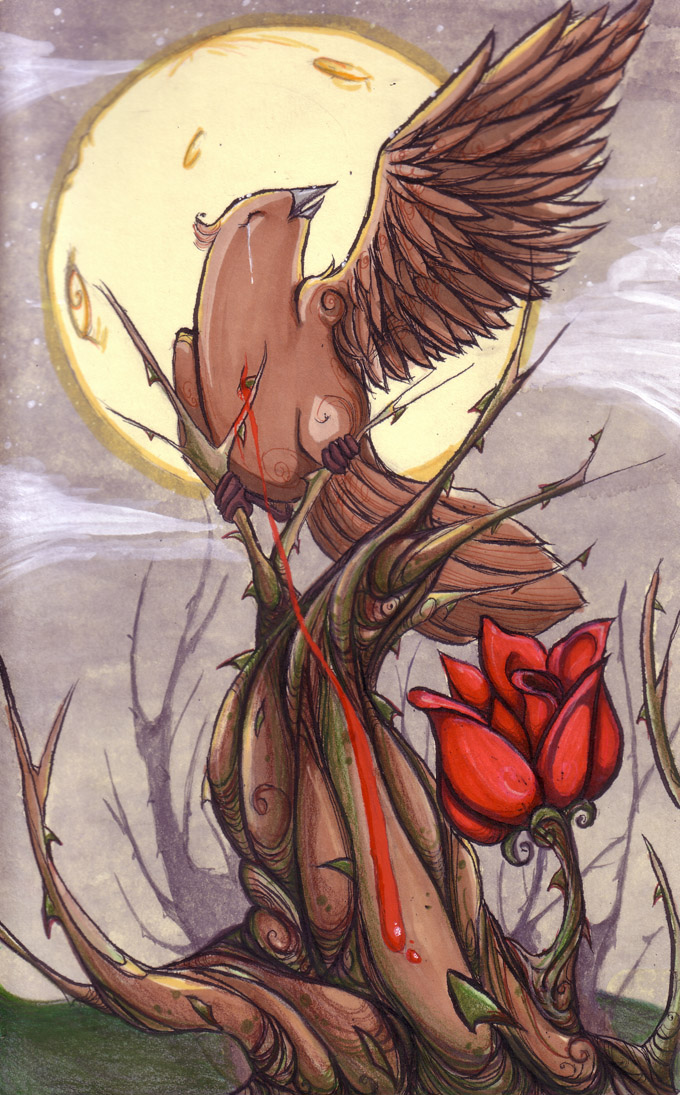
The Nightingale And The Rose

The Nightingale And The Rose

By Oscar Wilde

“ She said that she would dance with me if I brought her red roses,” cried the young Student; “but in all my garden there is no red rose.”

From her nest in the holm-oak tree the Nightingale heard him, and she looked out through the leaves, and wondered.

“No red rose in all my garden!” he cried, and his beautiful eyes filled with tears. “Ah, on what little things does happiness depend! I have read all that the wise men have written, and all the secrets of philosophy are mine, yet for want of a red rose is my life made wretched.”

“Here at last is a true lover,” said the Nightingale. “Night after night have I sung of him, though I knew him not: night after night have I told his story to the stars, and now I see him. His hair is dark as the hyacinth-blossom, and his lips are red as the rose of his desire; but passion has made his face like pale ivory, and sorrow has set her seal upon his brow.”

“The Prince gives a ball to-morrow night,” murmured the young Student, “and my love will be of the company. If I bring her a red rose she will dance with me till dawn. If I bring her a red rose, I shall hold her in my arms, and she will lean her head upon my shoulder, and her hand will be clasped in mine. But there is no red rose in my garden, so I shall sit lonely, and she will pass me by. She will have no heed of me, and my heart will break.”

“Here indeed is the true lover,” said the Nightingale. “What I sing of, he suffers—what is joy to me, to him is pain. Surely Love is a wonderful thing. It is more precious than emeralds, and dearer than fine opals. Pearls and pomegranates cannot buy it, nor is it set forth in the marketplace. It may not be purchased of the merchants, nor can it be weighed out in the balance for gold.”


“The musicians will sit in their gallery,” said the young Student, “and play upon their stringed instruments, and my love will dance to the sound of the harp and the violin. She will dance so lightly that her feet will not touch the floor, and the courtiers in their gay dresses will throng round her. But with me she will not dance, for I have no red rose to give her”; and he flung himself down on the grass, and buried his face in his hands, and wept.

“Why is he weeping?” asked a little Green Lizard, as he ran past him with his tail in the air.

“Why, indeed?” said a Butterfly, who was fluttering about after a sunbeam.

“Why, indeed?” whispered a Daisy to his neighbour, in a soft, low voice.

“He is weeping for a red rose,” said the Nightingale.

“For a red rose?” they cried; “how very ridiculous!” and the little Lizard, who was something of a cynic, laughed outright.

But the Nightingale understood the secret of the Student’s sorrow, and she sat silent in the oak-tree, and thought about the mystery of Love.

Suddenly she spread her brown wings for flight, and soared into the air. She passed through the grove like a shadow, and like a shadow she sailed across the garden.

ادامه نوشته

HOW WOULD YOU LIKE TO BE REMEMBERED?

About a hundred years ago, a man looked at the morning newspaper and to his surprise and horror, read his name in the obituary column. The newspapers had reported the death of the wrong person by mistake. His first response was shock. Am I here or there? When he regained his composure, his second thought was to find out what people had said about him. The obituary read, "Dynamite King Dies." And also "He was the merchant of death." This man was the inventor of dynamite and when he read the words "merchant of death," he asked himself a question, "Is this how I am going to be remembered?" He got in touch with his feelings and decided that this was not the way he wanted to be remembered. From that day on, he started working toward peace. His name was Alfred Nobel and he is remembered today by the great Nobel Prize.

Just as Alfred Nobel got in touch with his feelings and redefined his values, we should step back and do the same.

What is your legacy? How would you like to be remembered? Will you be spoken well of? Will you be remembered with love and respect? Will you be missed?

WORLD, MY SON STARTS SCHOOL TODAY!*

It is all going to be strange and new to him for a while, and I wish you would sort of treat him gently. You see, up to now, he has been king of the roost. He has been the boss of the backyard. I have always been around to repair his wounds, and I have always been handy to soothe his feelings.

But now things are going to be different. This morning he is going to walk down the front steps, wave his hand, and start on a great adventure that probably will include wars and tragedy and sorrow.

To live in this world will require faith and love and courage. So, World, I wish you would sort of take him by his young hand and teach him the things he will have to know. Teach him-but gently, if you can.

He will have to learn, I know, that all people are not just that all men and women are not true. Teach him that for every scoundrel, there is a hero; that for every enemy, there is a friend. Let him learn early that the bullies are the easiest people to lick.

Teach him the wonder of books. Give him quiet time to ponder the eternal mystery of birds in the sky, bees in the sun, and flowers on a green hill. Teach him that it is far more honorable to fail than to cheat. Teach him to have faith in his own ideas, even if everyone tells him they are wrong.

Try to give my son the strength not to follow the crowd when everyone else is getting on the bandwagon. Teach him to listen to others, but to filter all he hears on a screen of truth and to take only the good that comes through.

Teach him never to put a price tag on his heart and soul. Teach him to close his ears on the howling mob-and to stand and fight if he thinks he is right. Teach him gently, World, but do not coddle him, because only the test of fire makes fine steel.

This is a big order, World, but see what you can do. He is such a nice son.

Signed, Abraham Lincoln *adapted from "Pulpit Helps" February 1991, quoted in Apple Seeds, Volume 10, No.

1,1994.

SPOKEN WORDS CAN'T BE RETRIEVED

A farmer slandered his neighbor. Realizing his mistake, he went to the preacher to ask for forgiveness. The preacher told him to take a bag of feathers and drop them in the center of town. The farmer did as he was told. Then the preacher asked him to go and collect the feathers and put them back in the bag. The farmer tried but couldn't as the feathers had all blown away. When he returned with the empty bag, the preacher said, "The same thing is true about your words. You dropped them rather easily but you cannot retrieve them, so be very careful in choosing your words."


A man died and St. Peter asked him if he would like to go to heaven or hell. The man asked if he could see both before deciding.

St. Peter took him to hell first and the man saw a big hall with a long table, lots of food on it and music playing. He also saw rows of people with pale, sad faces. They looked starved and there was no laughter. And he observed one more thing. Their hands were tied to four-foot forks and knives and they were trying to get the food from the center of the table to put into their mouths. But they couldn't.

Then, he went to see heaven. There he saw a big hall with a long table, with lots of food on the table and music playing. He noticed rows of people on both sides of the table with their hands tied to four-foot forks and knives also. But he observed there was something different here. People were laughing and were well-fed and healthy-looking. He noticed that they were feeding one another across the table. The result was happiness, prosperity, enjoyment, and gratification because they were not thinking of themselves alone; they were thinking win/win. The same is true of our lives. When we serve our customers, our families, our employers and employees, we automatically win.

eagle

An eagle's egg was placed in the nest of a prairie chicken. The egg hatched and the little eagle grew up thinking it was a prairie chicken. The eagle did what the prairie chickens did. It scratched in the dirt for seeds. It clucked and cackled. It never flew more than a few feet because that is what the prairie chickens did. One day he saw an eagle flying gracefully and majestically in the open sky. He asked the prairie chickens: "What is that beautiful bird?" The chickens replied, "That is an eagle. He is an outstanding bird, but you cannot fly like him because you are just a prairie chicken." So the eagle never gave it a second thought, believing that to be the truth. He lived the life of and died a prairie chicken, depriving himself of his heritage because of his lack of vision. What a waste! He was born to win, but was conditioned to lose. The same thing is true of most people. The unfortunate part of life is as Oliver Wendall Holmes said, "Most people go to their graves, with music still in them." We don't achieve excellence because of our own lack of vision.

inside

There was a man who made a living selling balloons at a fair. He had all colors of balloons, including red, yellow, blue, and green. Whenever business was slow, he would release a helium-filled balloon into the air and when the children saw it go up, they all wanted to buy one. They would come up to him, buy a balloon, and his sales would go up again. He continued this process all day. One day, he felt someone tugging at his jacket.

He turned around and saw a little boy who asked, "If you release a black balloon, would that also fly?" Moved by the boy's concern, the man replied with empathy, "Son, it is not the color of the balloon, it is what is inside that makes it go up."

The Turtles

A turtle family decided to go on a picnic. The turtles, being naturally slow about things, took seven years to prepare for their outing. Finally the turtle family left home looking for a suitable place. During the second year of their journey they found a place ideal for them at last!

For about six months they cleaned the area, unpacked the picnic basket, and completed the arrangements. Then they discovered they had forgotten the salt. A picnic without salt would be a disaster, they all agreed. After a lengthy discussion, the youngest turtle was chosen to retrieve the salt from home. Although he was the fastest of the slow moving turtles, the little turtle whined, cried, and wobbled in his shell. He agreed to go on one condition: that no one would eat until he returned. The family consented and the little turtle left.

Three years passed and the little turtle had not returned. Five years...six years... then on the seventh year of his absence, the oldest turtle could no longer contain his hunger. He announced that he was going to eat and begun to unwrap a sandwich.
At that point the little turtle suddenly popped out from behind a tree shouting, 'See! I knew you wouldn't wait. Now I am not going to go get the salt.'

[Some of us waste our time waiting for people to live up to our expectations. We are so concerned about what others are doing that we don't do anything ourselves.]

The Pretty Lady

Once upon a time a big monk and a little monk were traveling together. They came to the bank of a river and found the bridge was damaged. They had to wade across the river. There was a pretty lady who was stuck at the damaged bridge and couldn't cross the river. The big monk offered to carry her across the river on his back. The lady accepted. The little monk was shocked by the move of the big monk. 'How can big brother carry a lady when we are supposed to avoid all intimacy with females?' thought the little monk. But he kept quiet. The big monk carried the lady across the river and the small monk followed unhappily. When they crossed the river, the big monk let the lady down and they parted ways with her.

All along the way for several miles, the little monk was very unhappy with the act of the big monk. He was making up all kinds of acussations about big monk in his head. This got him madder and madder. But he still kept quiet. And the big monk had no inclination to explain his situation. Finally, at a rest point many hours later, the little monk could not stand it any further, he burst out angrily at the big monk. 'How can you claim yourself a devout monk, when you seize the first opportunity to touch a female, especially when she is very pretty? All your teachings to me make you a big hypocrite. The big monk looked surprised and said, 'I had put down the pretty lady at the river bank many hours ago, how come you are still carrying her along?'


[This very old Chinese Zen story reflects the thinking of many people today. We encounter many unpleasant things in our life, they irritate us and they make us angry. Sometimes, they cause us a lot of hurt, sometimes they cause us to be bitter or jealous .. But like the little monk, we are not willing to let them go away. We keep on carrying the baggage of the 'pretty lady' with us. We let them keep on coming back to hurt us, make us angry, make us bitter and cause us a lot of agony. Why? Simply because we are not willing to put down or let go of the baggage of the 'pretty lady'. We should let go of the pretty lady immediately after crossing the river, that is after the unpleasant event is over. This will immediately remove all our agonies. There is no need to be further hurt by the unpleasant event after it is over.]

The Frogs

A farmer came into town and asked the owner of a restaurant if he could use a million frog legs. The restaurant owner was shocked and asked the man where he could get so many frog legs! The farmer replied, 'There is a pond near my house that is full of frogs - millions of them. They all croak all night long and they are about to make me crazy!' So the restaurant owner and the farmer made an agreement that the farmer would deliver frogs to the restaurant, five hundred at a time for the next several weeks.

The first week, the farmer returned to the restaurant looking rather sheepish, with two scrawny little frogs. The restaurant owner said, 'Well... where are all the frogs?' The farmer said, 'I was mistaken. There were only these two frogs in the pond. But they sure were making a lot of noise!'

[Next time you hear somebody criticizing or making fun of you, remember, it's probably just a couple of noisy frogs. Also remember that problems always seem bigger in the dark. Have you ever laid in your bed at night worrying about things which seem almost overwhelming like a million frogs croaking? Chances are pretty good that when the morning comes, and you take a closer look, you'll wonder what all the fuss was about.]

Enjoy your coffee!!!

'The happiest people in the world are not those who have no problems, but those who learn to live with things that are less than perfect.'

A group of graduates, highly established in their careers, got together to visit their old university professor. Conversation soon turned into complaints about stress in work and life.

Offering his guests coffee, the professor went to the kitchen and returned with a large pot of coffee and an assortment of cups - porcelain, plastic, glass, crystal, some plain looking, some expensive, some exquisite telling them to help themselves to the coffee.

When all the students had a cup of coffee, the professor said: 'If you noticed, all the nice looking expensive cups were taken up, leaving behind the simple and cheap ones. While it is normal for you to want only the best for yourselves, that is the source of your problems and stress. Be assured that the cup itself adds no quality to the coffee.


In most cases, it is just more expensive and in some cases even hides what we drink. What all of you really wanted was coffee, not the cup, but you consciously went for the best cups... Then you began eyeing each other's cups.'

Now consider this, said the professor, 'Life is the coffee; the jobs, money and position in society are the cups. They are just tools to hold and contain Life, and the type of cup we have does not define, nor change the quality of Life we live. Sometimes, by concentrating on the cup, we fail to enjoy the coffee God has provided us. Enjoy your coffee!'

The happiest people don't have the best of everything. They just make the best of everything. Four things to take note of in life...

1. Live simply.

2. Love generously.

3. Care deeply.

4. Speak kindly.

The Hand


A Thanksgiving Day editorial in the newspaper told of a school teacher who asked her class of first graders to draw a picture of something they were thankful for. She thought of how little these children from poor neighborhoods actually had to be thankful for. But she knew that most of them would draw pictures of turkeys or tables with food. The teacher was taken aback with the picture Douglas handed in.... a simple childishly drawn hand.

But whose hand? The class was captivated by the abstract image. "I think it must be the hand of God that brings us food," said one child. "A farmer," said another, "because he grows the turkeys." Finally when the others were at work, the teacher bent over Douglas's desk and asked whose hand it was. "It's your hand, Teacher," he mumbled.

She recalled that frequently at recess she had taken Douglas, a scrubby forlorn child by the hand. She often did that with the children. But it meant so much to Douglas. Perhaps this was everyone's Thanksgiving, not for the material things given to us but for the chance, in whatever small way, to give to others.

Source: Chicken Soup for the Soul

براي ديدن ترجمه، ادامه را بزنيد.

ادامه نوشته

Never Give Up

To know more about what your ability to believe in yourself can do, just imagine

a young girl who learned dancing when she was three-years old and whose greatest

passion remains dancing. She loses one of her legs in an accident. Read on this true

incident that took place almost 20 years ago and find out whether she gives up dancing

or fights back to realize what she believes in:

Sudha Chandran, a classical dancer from India, was cut off in the prime of her

career --quite literally -- when her right leg had to be amputated after a car accident.

Though the incident brought her bright career to a halt, she didn't give up.


In the painful months that followed, she met a doctor who developed an


artificial limb made from vulcanized rubber filled with sponge. She helped her to


use this new artificial leg. So intense was her desire that she decided to go back to


dancing after she had been fitted with an artificial leg. Sudha knew that she


believed in herself and could fulfill her dream, She began her courageous journey


back to the world of dancing - learning to balance, bend, stretch, walk, turn,


twist, twirl and finally dance.


After every public recital, she would ask her Dad about her performance.


"You still have a long way to go" was the answer she used to get in return.


In January 1984, Sudha made a historic comeback by giving a public recital


in Bombay. She performed in such a marvelous manner that it moved everyone to


tears while catapulting her to the number one position again. That evening when


she asked the usual question her dad, he didn't say anything. He just touched her


feet as a tribute to a great artiste.


Sudha's comeback was such heart-warming that a film producer was


inspired to capture the incident into a celluloid box office hit `Mayuri.' When


someone asked Sudha how she had managed to dance again, she said quite


simply, : "YOU DON'T NEED FEET TO DANCE."

Think About It!


If we could shrink the earth's population to a village

of precisely 100 people, with all the existing human

ratios remaining the same, it would look something

like the following :

There would be:

57 Asians

21 Europeans

14 from the Western Hemisphere, both north and south

8 Africans

52 would be female

48 would be male

70 would be non-white

30 would be white

70 would be non-Christian

30 would be Christian

6 people would possess 59% of the entire world's

wealth and all 6 would be from the United States.

80 would live in substandard housing

70 would be unable to read

50 would suffer from malnutrition

1 would be near death; 1 would be near birth

1 (yes, only 1) would have a college education

1 would own a computer

ادامه نوشته

A Shoulder to Cry on

My mother used to ask me what is the most important part of the body. Through the

years I would take a guess at what I thought was the correct answer. When I was

younger, I thought sound was very important to us as humans, so I said, "My ears,

Mommy." She said, "No -- Many people are deaf. But you keep thinking about it and I

will ask you again soon."

Several years passed before she asked me again. Since making my first attempt, I had

contemplated the correct answer. So this time I told her, "Mommy, sight is very

important to everybody, so it must be our eyes." She looked at me and told me, "You

are learning fast, but the answer is not correct because there are many people who are

blind." Stumped again, I continued my quest for knowledge and over the years, Mother

asked me a couple more times and always her answer was, "No. But you are getting

smarter every year, my young child."

Then last year, my grandpa died. Everybody was hurt. Everybody was crying. Even my

father cried. I remember that especially because it was only the second time I saw him

cry. My Mom looked at me when it was our turn to say our final good-bye to Grandpa.

She asked me, "Do you know the most important body part yet, my son?"

I was shocked when she asked me this now. I always thought this was a game between

her and me. She saw the confusion on my face and told me, "This question is very

important. It shows that you have really lived in your life. For every body part you gave

me in the past, I have told you was wrong and I have given you an example why. But

today is the day you need to learn this important lesson." She looked down at me as

only a mother can. I saw her eyes well up with tears. She said, "Son, the most

important body part is your shoulder."

I asked, "Is it because it holds up my head?" She replied, "No, it is because it can hold

the head of a friend or a loved one when they cry. Everybody needs a shoulder to cry on

sometime in life, my son. I only hope that you have enough love and friends that you

will always have a shoulder to cry on when you need it."

Then and there I knew the most important body part is not a selfish one -- it is

sympathetic to the pain of Others.

People will forget what you said ... People will forget what you did... But people will

Never Forget how you made them feel


Anyone Home?

One day a 6 year old girl was sitting in a classroom. The teacher was going to

explain evolution to the children. The teacher asked a little boy:

TEACHER: Tommy do you see the tree outside?

TOMMY: Yes.

TEACHER: Do you see the grass outside?

TOMMY: Yes.

TEACHER: Go outside and look up and see if you can see the sky.

TOMMY: Okay. (He returned a few minutes later) Yes, I saw the sky.

TEACHER: Did you see God?

TOMMY: No.

TEACHER: That's my point. We can't see God because he isn't there. He

doesn't exist.

A little girl spoke up and wanted to ask the boy some questions. The teacher

agreed and the little girl asked the boy:

LITTLE GIRL: Tommy, do you see the tree outside?

TOMMY: Yes.

LITTLE GIRL: Tommy, do you see the grass outside?

TOMMY: Yessssssss (getting tired of the questions by this time.

LITTLE GIRL: Do you see the teacher?

TOMMY: Yes

LITTLE GIRL: Do you see her brain?

TOMMY: No

LITTLE GIRL: Then according to what we were taught today in school she

must not have one!

"FOR WE WALK BY FAITH, NOT BY SIGHT"

THE BOY AND THE APPLE TREE

A long time ago, there was a huge apple tree. A little boy loved to come and play

around it everyday. He climbed to the treetop, ate the apples, and took a nap under the

shadow. He loved the tree and the tree loved to play with him. Time went by, the little

boy had grown up and he no longer played around the tree every day.

One day, the boy came back to the tree and he looked sad.

"Come and play with me", the tree asked the boy.

"I am no longer a kid, I do not play around trees any more" the boy replied.

"I want toys. I need money to buy them."

"Sorry, but I do not have money, but you can pick all my apples and sell them. So, you

will have money."

The boy was so excited. He grabbed all the apples on the tree and

left happily. The boy never came back after he picked the apples.

The tree was sad.

One day, the boy who now turned into a man returned and the tree

was excited.

"Come and play with me" the tree said.

ادامه نوشته

a story

One day a donkey fell into a well. The farmer couldn't get him out, so he knew he had to cover him up. He called in his neighbors, and they all started to throw dirt down the well, but instead of burying the animal, the donkey would shake the dirt off and take a step up. Pretty soon, the pile of dirt got so high that the donkey stepped over the edge of the well. Moralists use this story to preach that all our troubles can be stepping stones, that we shouldn't give up; instead shake it off and take a step up. Comedians, however, note that as soon as the disdained donkey got to the top he ran over and bit the farmer. Their moral is that if something goes wrong, try to cover your ass. It can come back and bite you.

THE GULISTAN OF SA’DI

Sheikh Muslih-uddin Sa’di Shirazi

Electronically Enhanced Text (c) Copyright 1991, World Library, Inc.

Sadi, Sheykh Moslehoddin (1184-1291) - Perhaps the most popular Persian poet of all time, Sadi wandered through other countries for thirty years and lived to be 107 years old. Gulistan (The Rose Garden) (1258) - A collection of poems which include stories of love, youth, old-age, and social duties, along with many moral reflections and philosophical sayings. It is Sadi’s most celebrated work.

INTRODUCTORY

IN THE NAME OF ALLAH THE MERCIFUL THE CLEMENT

Laudation to the God of majesty and glory! Obedience to him is a cause of approach and gratitude in increase of benefits. Every inhalation of the breath prolongs life and every expiration of it gladdens our nature; wherefore every breath confers two benefits and for every benefit gratitude is due.

     Whose hand and tongue is capable To fulfil the obligations of thanks to him?     Words of the most high: Be thankful, O family of David, and but few of my servants are thankful.

     It is best to a worshipper for his transgressions To offer apologies at the throne of God, Although what is worthy of his dignity No one is able to accomplish.

ادامه نوشته

SILAS MARNER-PART TWO

 CHAPTER SIXTEEN

 IT was a bright autumn Sunday, sixteen years after Silas Marner had found his new treasure on the hearth. The bells of the old Raveloe church were ringing the cheerful peal which told that the morning service was ended; and out of the arched doorway in the tower came slowly, retarded by friendly greetings and questions, the richer parishioners who had chosen this bright Sunday morning as eligible for church-going. It was the rural fashion of that time for the more important members of the congregation to depart first, while their humbler neighbours waited and looked on, stroking their bent heads or dropping their curtsies to any large ratepayer who turned to notice them.

ادامه نوشته

SILAS MARNER

 George Eliot

PART ONE 

CHAPTER ONE

IN the days when the spinning-wheels hummed busily in the farmhouses- and even great ladies, clothed in silk and thread-lace, had their toy spinning-wheels of polished oak- there might be seen, in districts far away among the lanes, or deep in the bosom of the hills, certain pallid undersized men, who, by the side of the brawny country-folk, looked like the remnants of a disinherited race. The shepherd’s dog barked fiercely when one of these alien-looking men appeared on the upland, dark against the early winter sunset; for what dog likes a figure bent under a heavy bag?- and these pale men rarely stirred abroad without that mysterious burden.

The shepherd himself, though he had good reason to believe that the bag held nothing but flaxen thread, or else the long rolls of strong linen spun from that thread, was not quite sure that this trade of weaving, indispensable though it was, could be carried on entirely without the help of the Evil One. In that far-off time superstition clung easily round every person or thing that was at all unwonted, or even intermittent and occasional merely, like the visits of the pedlar or the knife-grinder. No one knew where wandering men had their homes or their origin; and how was a man to be explained unless you at least knew somebody who knew his father and mother? To the peasants of old times, the world outside their own direct experience was a region of vagueness and mystery: to their untravelled thought a state of wandering was a conception as dim as the winter life of the swallows that came back with the spring; and even a settler, if he came from distant parts, hardly ever ceased to be viewed with a remnant of distrust, which would have prevented any surprise if a long course of inoffensive conduct on his part had ended in the commission of a crime; especially if he had any reputation for knowledge, or showed any skill in handicraft. All cleverness, whether in the rapid use of that difficult instrument the tongue, or in some other art unfamiliar to villagers, was in itself suspicious: honest folks, born and bred in a visible manner, were mostly not overwise or clever- at least, not beyond such a matter as knowing the signs of the weather; and the process by which rapidity and dexterity of any kind were acquired was so wholly hidden, that they partook of the nature of conjuring. In this way it came to pass that those scattered linen-weavers- emigrants from the town into the country- were to the last regarded as aliens by their rustic neighbours, and usually contracted the eccentric habits which belong to a state of loneliness.


ادامه نوشته

Animal Farm Part 10

YEARS passed. The seasons came and went, the short animal lives fled
by. A time came when there was no one who remembered the old days
before the Rebellion, except Clover, Benjamin, Moses the raven, and a
number of the pigs.

ادامه نوشته

AnimalFarm Part 6

ALL that year the animals worked like slaves. But they were happy in
their work; they grudged no effort or sacrifice, well aware that
everything that they did was for the benefit of themselves and those of
their kind who would come after them, and not for a pack of idle,
thieving human beings.
Throughout the spring and summer they worked a sixty-hour week, and
in August Napoleon announced that there would be work on Sunday
afternoons as well. This work was strictly voluntary, but any animal
who absented himself from it would have his rations reduced by half.
Even so, it was found necessary to leave certain tasks undone. The
harvest was a little less successful than in the previous year, and two
fields which should have been sown with roots in the early summer
were not sown because the ploughing had not been completed early
enough. It was possible to foresee that the coming winter would be a
hard one.
The windmill presented unexpected difficulties. There was a good
quarry of limestone on the farm, and plenty of sand and cement had
been found in one of the outhouses, so that all the materials for building
were at hand. But the problem the animals could not at first solve was
how to break up the stone into pieces of suitable size. There seemed no
way of doing this except with picks and crowbars, which no animal
could use, because no animal could stand on his hind legs. Only after
weeks of vain effort did the right idea occur to somebody-namely, to
utilise the force of gravity. Huge boulders, far too big to be used as they
were, were lying all over the bed of the quarry. The animals lashed
ropes round these, and then all together, cows, horses, sheep, any
animal that could lay hold of the rope-even the pigs sometimes joined
in at critical moments-they dragged them with desperate slowness up
the slope to the top of the quarry, where they were toppled over the
edge, to shatter to pieces below. Transporting the stone when it was
once broken was comparatively simple. The horses carried it off in
cart-loads, the sheep dragged single blocks, even Muriel and Benjamin
yoked themselves into an old governess-cart and did their share. By late
summer a sufficient store of stone had accumulated, and then the
building began, under the superintendence of the pigs.

ادامه نوشته

The 4 Wives


There was a rich merchant who had 4 wives. He loved the 4th wife the most and adorned her with rich robes and treated her to delicacies. He took great care of her and gave her nothing but the best.
He also loved the 3rd wife very much. He's very proud of her and always wanted to show off her to his friends. However, the merchant is always in great fear that she might run away with some other men.
He too, loved his 2nd wife. She is a very considerate person, always patient and in fact is the merchant's confidante. Whenever the merchant faced some problems, he always turned to his 2nd wife and she would always help him out and tide him through difficult times.
Now, the merchant's 1st wife is a very loyal partner and has made great contributions in maintaining his wealth and business as well as taking care of the household. However, the merchant did not love the first wife and although she loved him deeply, he hardly took notice of her.
One day, the merchant fell ill. Before long, he knew that he was going to die soon. He thought of his luxurious life and told himself, "Now I have 4 wives with me. But when I die, I'll be alone. How lonely I'll be!"
Thus, he asked the 4th wife, "I loved you most, endowed you with the finest clothing and showered great care over you. Now that I'm dying, will you follow me and keep me company?" "No way!" replied the 4th wife and she walked away without another word.
The answer cut like a sharp knife right into the merchant's heart.
The sad merchant then asked the 3rd wife, "I have loved you so much for all my life. Now that I'm dying, will you follow me and keep me company?" "No!" replied the 3rd wife. "Life is so good over here! I'm going to remarry when you die!" The merchant's heart sank and turned cold.
He then asked the 2nd wife, "I always turned to you for help and you've always helped me out. Now I need your help again. When I die, will you follow me and keep me company?" "I'm sorry, I can't help you out this time!" replied the 2nd wife. "At the very most, I can only send you to your grave." The answer came like a bolt of thunder and the merchant was devastated.
Then a voice called out : "I'll leave with you. I'll follow you no matter where you go." The merchant looked up and there was his first wife. She was so skinny, almost like she suffered from malnutrition. Greatly grieved, the merchant said, "I should have taken much better care of you while I could have !"
Actually, we all have 4 wives in our lives
a. The 4th wife is our body. No matter how much time and effort we lavish in making it look good, it'll leave us when we die.
b. Our 3rd wife ? Our possessions, status and wealth. When we die, they all go to others.
c. The 2nd wife is our family and friends. No matter how close they had been there for us when we're alive, the furthest they can stay by us is up to the grave.
d. The 1st wife is in fact our soul, often neglected in our pursuit of material, wealth and sensual pleasure.
Guess what? It is actually the only thing that follows us wherever we go. Perhaps it's a good idea to cultivate and strengthen it now rather than to wait until we're on our deathbed to lament.

A Box Full of Kisses


The story goes that some time ago, a man punished his 3-year-old daughter for wasting a roll of gold wrapping paper. Money was tight and he became infuriated when the child tried to decorate a box to put under the Christmas tree. Nevertheless, the little girl brought the gift to her father the next morning and said, "This is for you, Daddy." The man was embarrassed by his earlier overreaction, but his anger flared again when he found out the box was empty. He yelled at her, stating, "Don't you know, when you give someone a present, there is supposed to be something inside? The little girl looked up at him with tears in her eyes and cried, "Oh, Daddy, it's not empty at all. I blew kisses into the box. They're all for you, Daddy."The father was crushed. He put his arms around his little girl, and he begged for her forgiveness. Only a short time later, an accident took the life of the child. It is also told that her father kept that gold box by his bed for many years and, whenever he was discouraged, he would take out an imaginary kiss and remember the love of the child who had put it there.
In a very real sense, each one of us, as humans beings, have been given a gold container filled with unconditional love and kisses... from our children, family members, friends, and God. There is simply no other possession, anyone could hold, more precious than this.

Alexander Fleming


His name was Fleming, and he was a poor Scottish farmer. One day, while trying to eke out a living for his family, he heard a cry for help coming from a nearby bog. He dropped his tools and ran to the bog. There, mired to his waist in black muck, was a terrified boy, screaming and struggling to free himself. Farmer Fleming saved the lad from what could have been a slowand terrifying death. The next day, a fancy carriage pulled up to the Scotsman's sparse surroundings. An elegantly dressed nobleman stepped out and introduced himself as the father of the boy Farmer Fleming had saved."I want to repay you," said the nobleman. "You saved my son's life.""No, I can't accept payment for what I did," the Scottish farmer replied, waving off the offer. At that moment, the farmer's own son came to the door of the family hovel."Is that your son?" the nobleman asked. "Yes," the farmer replied proudly."I'll make you a deal. Let me take him and give him a good education.If the lad is anything like his father, he'll grow to a man you can be proud of."And that he did. In time, Farmer Fleming's son graduated from St. Mary's Hospital Medical School in London, and went on to become known throughout the world as the noted Sir Alexander Fleming, the discoverer of Penicillin.Years afterward, the nobleman's son was stricken with pneumonia. What saved him? Penicillin.The name of the nobleman? Lord Randolph Churchill.His son's name? Sir Winston Churchill.
Someone once said what goes around comes around.

Dad's Blessing

A young man was getting ready to graduate from college. For many months he had admired a beautiful sports car in a dealer's showroom, and knowing his father could well afford it, he told him that was all he wanted.

As Graduation Day approached, the young man awaited
signs that his father had purchased the car. Finally, on the morning of his graduation, his father called him into his private study. His father told him how proud he was to have such a fine son, and told him how much he loved him. He handed his son a beautifully wrapped gift box. Curious, but somewhat disappointed, the young man opened the box and found a lovely, leather-bound Bible, with the young man's name embossed in gold. Angry, he raised his voice to his father and said "With all your money, you give me a Bible?" and stormed out of the house, leaving the Bible.

Many years passed and the young man was very successful in business. He had a beautiful home and wonderful family, but realized his father was very old, and thought perhaps he should go to him. He had not seen him since that graduation day. Before he could make arrangements, he received a telegram telling him his father had passed away, and willed all of his possessions to his son. He needed to come home immediately and take care of things.

When he arrived at his father's house, sudden sadness and regret filled his heart. He began to search through his father's important papers and saw the still new Bible, just as he had left it years ago. With tears, he opened the Bible and began to turn the pages. And as he did, a car key dropped from the back of the Bible. It had a tag with the dealer's name, the same dealer who had the sports car he had desired. On the tag was the date of his graduation, and the words PAID IN FULL.

How many times do we miss Spirit's blessings and answers to our prayers because they do not arrive exactly as we have expected?

Animal Farm part 5

V

AS WINTER drew on, Mollie became more and more troublesome.

She was late for work every morning and excused herself by saying that

she had overslept, and she complained of mysterious pains, although

her appetite was excellent. On every kind of pretext she would run

away from work and go to the drinking pool, where she would stand

foolishly gazing at her own reflection in the water. But there were also

rumours of something more serious. One day, as Mollie strolled

blithely into the yard, flirting her long tail and chewing at a stalk of

hay, Clover took her aside.

"Mollie," she said, "I have something very serious to say to you. This

morning I saw you looking over the hedge that divides Animal Farm

from Foxwood. One of Mr. Pilkington's men was standing on the other

side of the hedge. And-I was a long way away, but I am almost certain I

saw this-he was talking to you and you were allowing him to stroke

your nose. What does that mean, Mollie?"

"He didn't! I wasn't! It isn't true!" cried Mollie, beginning to prance

about and paw the ground.

"Mollie! Look me in the face. Do you give me your word of honour

that that man was not stroking your nose?"

"It isn't true!" repeated Mollie, but she could not look Clover in the

face, and the next moment she took to her heels and galloped away into

the field.

A thought struck Clover. Without saying anything to the others, she

went to Mollie's stall and turned over the straw with her hoof. Hidden

under the straw was a little pile of lump sugar and several bunches of

ribbon of different colours.

ادامه نوشته

Animal Farm part 4

IV

BY THE late summer the news of what had happened on Animal Farm

had spread across half the county. Every day Snowball and Napoleon

sent out flights of pigeons whose instructions were to mingle with the

animals on neighbouring farms, tell them the story of the Rebellion,

and teach them the tune of Beasts of England.

Most of this time Mr. Jones had spent sitting in the taproom of the Red

Lion at Willingdon, complaining to anyone who would listen of the

monstrous injustice he had suffered in being turned out of his property

by a pack of good-for-nothing animals. The other farmers sympathised

in principle, but they did not at first give him much help. At heart, each

of them was secretly wondering whether he could not somehow turn

Jones's misfortune to his own advantage. It was lucky that the owners

of the two farms which adjoined Animal Farm were on permanently

bad terms. One of them, which was named Foxwood, was a large,

neglected, old-fashioned farm, much overgrown by woodland, with all

its pastures worn out and its hedges in a disgraceful condition. Its

owner, Mr. Pilkington, was an easy-going gentleman farmer who spent

most of his time in fishing or hunting according to the season. The

other farm, which was called Pinchfield, was smaller and better kept.

Its owner was a Mr. Frederick, a tough, shrewd man, perpetually

involved in lawsuits and with a name for driving hard bargains. These

two disliked each other so much that it was difficult for them to come

to any agreement, even in defence of their own interests.

Nevertheless, they were both thoroughly frightened by the rebellion on

Animal Farm, and very anxious to prevent their own animals from

learning too much about it. At first they pretended to laugh to scorn the

idea of animals managing a farm for themselves. The whole thing

would be over in a fortnight, they said. They put it about that the

animals on the Manor Farm (they insisted on calling it the Manor Farm;

they would not tolerate the name "Animal Farm") were perpetually

ادامه نوشته

Animal Farm part 3

III

HOW they toiled and sweated to get the hay in! But their efforts were

rewarded, for the harvest was an even bigger success than they had

hoped.

Sometimes the work was hard; the implements had been designed for

human beings and not for animals, and it was a great drawback that no

animal was able to use any tool that involved standing on his hind legs.

But the pigs were so clever that they could think of a way round every

difficulty. As for the horses, they knew every inch of the field, and in

fact understood the business of mowing and raking far better than Jones

and his men had ever done. The pigs did not actually work, but directed

and supervised the others. With their superior knowledge it was natural

that they should assume the leadership. Boxer and Clover would

harness themselves to the cutter or the horse-rake (no bits or reins were

needed in these days, of course) and tramp steadily round and round the

field with a pig walking behind and calling out "Gee up, comrade!" or

"Whoa back, comrade!" as the case might be. And every animal down

to the humblest worked at turning the hay and gathering it. Even the

ducks and hens toiled to and fro all day in the sun, carrying tiny wisps

of hay in their beaks. In the end they finished the harvest in two days'

less time than it had usually taken Jones and his men. Moreover, it was

the biggest harvest that the farm had ever seen. There was no wastage

whatever; the hens and ducks with their sharp eyes had gathered up the

very last stalk. And not an animal on the farm had stolen so much as a

mouthful.

All through that summer the work of the farm went like clockwork. The

animals were happy as they had never conceived it possible to be.

Every mouthful of food was an acute positive pleasure, now that it was

truly their own food, produced by themselves and for themselves, not

doled out to them by a grudging master. With the worthless parasitical

human beings gone, there was more for everyone to eat. There was

more leisure too, inexperienced though the animals were. They met

with many difficulties-for instance, later in the year, when they

harvested the corn, they had to tread it out in the ancient style and blow

away the chaff with their breath, since the farm possessed no threshing

ادامه نوشته

Animal Farm part 2

II

THREE nights later old Major died peacefully in his sleep. His body

was buried at the foot of the orchard.

This was early in March. During the next three months there was much

secret activity. Major's speech had given to the more intelligent animals

on the farm a completely new outlook on life. They did not know when

the Rebellion predicted by Major would take place, they had no reason

for thinking that it would be within their own lifetime, but they saw

clearly that it was their duty to prepare for it. The work of teaching and

organising the others fell naturally upon the pigs, who were generally

recognised as being the cleverest of the animals. Pre-eminent among

the pigs were two young boars named Snowball and Napoleon, whom

Mr. Jones was breeding up for sale. Napoleon was a large, rather

fierce-looking Berkshire boar, the only Berkshire on the farm, not much

of a talker, but with a reputation for getting his own way. Snowball was

a more vivacious pig than Napoleon, quicker in speech and more

inventive, but was not considered to have the same depth of character.

All the other male pigs on the farm were porkers. The best known

among them was a small fat pig named Squealer, with very round

cheeks, twinkling eyes, nimble movements, and a shrill voice. He was a

brilliant talker, and when he was arguing some difficult point he had a

way of skipping from side to side and whisking his tail which was

somehow very persuasive. The others said of Squealer that he could

turn black into white.

These three had elaborated old Major's teachings into a complete

system of thought, to which they gave the name of Animalism. Several

nights a week, after Mr. Jones was asleep, they held secret meetings in

the barn and expounded the principles of Animalism to the others. At

the beginning they met with much stupidity and apathy. Some of the

animals talked of the duty of loyalty to Mr. Jones, whom they referred

to as "Master," or made elementary remarks such as "Mr. Jones feeds

us. If he were gone, we should starve to death." Others asked such

questions as "Why should we care what happens after we are dead?" or

"If this Rebellion is to happen anyway, what difference does it make

whether we work for it or not?", and the pigs had great difficulty in

making them see that this was contrary to the spirit of Animalism. The

stupidest questions of all were asked by Mollie, the white mare. The

very first question she asked Snowball was: "Will there still be sugar

after the Rebellion?"

"No," said Snowball firmly. "We have no means of making sugar on

this farm. Besides, you do not need sugar. You will have all the oats

and hay you want."

"And shall I still be allowed to wear ribbons in my mane?" asked


ادامه نوشته

Animal Farm Part 9

BOXER'S split hoof was a long time in healing. They had started the
rebuilding of the windmill the day after the victory celebrations were
ended Boxer refused to take even a day off work, and made it a point of
honour not to let it be seen that he was in pain. In the evenings he would admit privately to Clover that the hoof troubled him a great deal.

ادامه نوشته

Animal Farm Part 8

A FEW days later, when the terror caused by the executions had died
down, some of the animals remembered-or thought they
remembered-that the Sixth Commandment decreed "No animal shall
kill any other animal." And though no one cared to mention it in the
hearing of the pigs or the dogs, it was felt that the killings which had
taken place did not square with this.

ادامه نوشته

Animal Farm Part 7

IT WAS a bitter winter. The stormy weather was followed by sleet and
snow, and then by a hard frost which did not break till well into
February. The animals carried on as best they could with the rebuilding
of the windmill, well knowing that the outside world was watching
them and that the envious human beings would rejoice and triumph if
the mill were not finished on time.

ادامه نوشته

ANIMAL FARM -Part1

ANIMAL FARM

by George Orwell

I

MR. JONES, of the Manor Farm, had locked the hen-houses for the

night, but was too drunk to remember to shut the popholes. With the

ring of light from his lantern dancing from side to side, he lurched

across the yard, kicked off his boots at the back door, drew himself a

last glass of beer from the barrel in the scullery, and made his way up to

bed, where Mrs. Jones was already snoring.

As soon as the light in the bedroom went out there was a stirring and a

fluttering all through the farm buildings. Word had gone round during

the day that old Major, the prize Middle White boar, had had a strange

dream on the previous night and wished to communicate it to the other

animals. It had been agreed that they should all meet in the big barn as

soon as Mr. Jones was safely out of the way. Old Major (so he was

always called, though the name under which he had been exhibited was

Willingdon Beauty) was so highly regarded on the farm that everyone

was quite ready to lose an hour's sleep in order to hear what he had to

say.

At one end of the big barn, on a sort of raised platform, Major was

already ensconced on his bed of straw, under a lantern which hung from

a beam. He was twelve years old and had lately grown rather stout, but

he was still a majestic-looking pig, with a wise and benevolent

appearance in spite of the fact that his tushes had never been cut.

Before long the other animals began to arrive and make themselves

comfortable after their different fashions. First came the three dogs,

Bluebell, Jessie, and Pincher, and then the pigs, who settled down in the

straw immediately in front of the platform. The hens perched

themselves on the window-sills, the pigeons fluttered up to the rafters,

the sheep and cows lay down behind the pigs and began to chew the cud.


ادامه نوشته

If I Had My Life To Live Over

  Interviews with the elderly and the terminally ill do not report that

people have regret for the things they have done but rather people talk

about the things they regret not having done.

I'd dare to make more mistakes next time.

I'd relax. I would limber up.

I would be sillier than I have been this trip.  

I would take fewer things seriously.

I would take more chances.

I would take more trips.

I would climb more mountains and swim more rivers. I

would eat more ice cream and less beans. I would perhaps have more

actual troubles but I'd have fewer imaginary ones. You see, I'm one of those people who live sensibly and sanely hour after hour, day after day. Oh, I've had my moments and if I had it to do over again, I'd have more of them. In fact, I'd try to have nothing else. Just moments. One after another, instead of living so many years ahead of each day.

I've been one of those people who never go anywhere without a

thermometer, a hot water bottle, a raincoat and a parachute.

If I had it to do again, I would travel lighter next time.

If I had my life to live over, I would start barefoot earlier

in the spring and stay that way later in the fall. I would go to more

dances. I would ride more merry-go-rounds. I would pick more daisies.

Nadine Stair -age 85


IF I HAD MY LIFE TO LIVE OVER

 by Erma Bombeck


(Written after she found out she was dying from cancer).


I would have gone to bed when I was sick instead of pretending the earth would go into a holding pattern if I weren't there for the day.
I would have burned the pink candle sculpted like a rose before it melted in storage.
I would have talked less and listened more.
I would have invited friends over to dinner even if the carpet was stained, or the sofa faded
I would have eaten the popcorn in the 'good' living room and worried much less about the dirt when someone wanted to light a fire in the fireplace.
I would have taken the time to listen to my grandfather ramble about his youth.
I would have shared more of the responsibility carried by my husband.
I would never have insisted the car windows be rolled up on a summer day because my hair had just been teased and sprayed.
I would have sat on the lawn! With my grass stains.
I would have cried and laughed less while watching television and more while watching life.
I would never have bought anything just because it was practical, wouldn't show soil, or was guaranteed to last a lifetime.
Instead of wishing away nine months of pregnancy, I'd have cherished every moment and realized that the wonderment growing inside me was the only chance in life to assist God in a miracle.
When my kids kissed me impetuously, I would never have said, "Later.  Now go get washed up for dinner."  There would have been more "I love
you's "; more "I'm sorry's ."
But mostly, given another shot at life, I would seize every minute...look at it and really see it. live it and never give it back.  STOP SWEATING THE SMALL STUFF!!!

Don't worry about who doesn't like you, who has more, or who's doing what
Instead; let's cherish the relationships we have with those who do love us.
Let's think about what God HAS blessed us with, and what we are doing each day to promote ourselves mentally, physically, and emotionally.


I hope you have a blessed day .


Love: The One Creative Force

Spread love everywhere you go: first of all in your own


house. Give love to your children, to your wife or


husband, to a next door neighbor. . . . Let no one ever


come to you without leaving better and happier. Be the


living expression of God's kindness; kindness in your


face, kindness in your eyes, kindness in your smile,


kindness in your warm greeting.


Mother Teresa


A college professor had his sociology class go into the Baltimore slums to get case histories of 200 young boys. They were asked to write an evaluation of each boy's future. In every case the students wrote, "He hasn't got a chance." Twenty-five years later another sociology professor came across the earlier study. He had his students follow up on the project to see what had happened to these boys. With the exception of 20 boys who had moved away or died, the students learned that 176 of the remaining 180 had achieved more than ordinary success as lawyers, doctors and businessmen.

The professor was astounded and decided to pursue the matter further. Fortunately, all the men were in the area and he was able to ask each one, "How do you account for your success?" In each case the reply came with feeling, 'There was a teacher."

The teacher was still alive, so he sought her out and asked the old but still alert lady what magic formula she had used to pull these boys out of the slums into successful achievement.

The teacher's eyes sparkled and her lips broke into a gentle smile. "It's really very simple," she said. "I loved those boys."

Eric Butterworth

نامه ي پدري به فرزندش

FATHER FORGETS

W. Livingston Larned

Listen, son: I am saying this as you lie asleep, one little paw crumpled under your cheek and the blond curls stickily wet on your damp forehead. I have stolen into your room alone. Just a few minutes ago, as I sat reading my paper in the library, a stifling wave of remorse swept over me. Guiltily I came to your bedside.

There are the things I was thinking, son: I had been cross to you. I scolded you as you were dressing for school because you gave your face merely a dab with a towel. I took you to task for not cleaning your shoes. I called out angrily when you threw some of your things on the floor.

At breakfast I found fault, too. You spilled things. You gulped down your food. You put your elbows on the table. You spread butter too thick on your bread. And as you started off to play and I made for my train, you turned and waved a hand and called, "Goodbye, Daddy!" and I frowned, and said in reply, "Hold your shoulders back!"

Then it began all over again in the late afternoon. As I came up the road I spied you, down on your knees, playing marbles. There were holes in your stockings. I humiliated you before your boyfriends by marching you ahead of me to the house. Stockings were expensive -and if you had to buy them you would be more careful! Imagine that, son, from a father!

Do you remember, later, when I was reading in the library, how you came in timidly, with a sort of hurt look in your eyes? When I glanced up over my paper, impatient at the interruption, you hesitated at the door. "What is it you want?" I snapped.

You said nothing, but ran across in one tempestuous plunge, and threw your arms around my neck and kissed me, and your small arms tightened with an affection that God had set blooming in your heart and which even neglect could not wither. And then you were gone, pattering up the stairs.

Well, son, it was shortly afterwards that my paper slipped from my hands and a terrible sickening fear came over me. What has habit been doing to me? The habit of finding fault, of reprimanding - this was my reward to you for being a boy. It was not that I did not love you; it was that I expected too much of youth. I was measuring you by the yardstick of my own years.

And there was so much that was good and fine and true in your character. The little heart of you was as big as the dawn itself over the wide hills. This was shown by your spontaneous impulse to rush in and kiss me good night. Nothing else matters tonight, son. I have come to your bed-side in the darkness, and I have knelt there, ashamed!

It is a feeble atonement; I know you would not understand these things if I told them to you during your waking hours. But tomorrow I will be a real daddy! I will chum with you, and suffer when you suffer, and laugh when you laugh. I will bite my tongue when impatient words come. I will keep saying as if it were a ritual: "He is nothing but a boy - a little boy!"

I           am afraid I have visualized you as a man. Yet as I see you now son, crumpled and weary in your cot, I see that you are still a baby. Yesterday you were in your mother's arms, your head on her shoulder. I have asked too much, too much.


A Joke

One person wrote a letter to his wife: "Dear Sweet Heart, I can't send my salary this month, so I am sending 100 kisses. You are my sweetheart" His wife replied back after some days to her husband: "Dearest sweetheart, Thanks for your 100 kisses, I am sending the expenses details.

1. Milk man was agreed on 2 kisses

2. Teacher agreed on 7 kisses

3. Our house owner is coming every day and taking two or three kisses of mine

4. Vegetable and food shop keeper was not agreeing with kisses only, so I have given some other items to him ...........

5. Others 40 kisses.

Please don't worry for me, I have balance 35 kisses and I hope I can complete this month. Shall I plan same way for next months?

Please advise,

Your Sweet Heart


Stories about Proverbs


The Camel and the Giraffe


Once, the camel and the giraffe quarreled and quarreled. They brought offenses each other; or the giraffe has a neck too long or the camel has the hump too big. One day the savanna burned and the fire drove away them in the desert. They caught only to take something to eat and a little water.  On the way, the camel kept food for the giraffe, said: "I have enough reserves in my hump!" When they arrived to an oasis came the turn of the giraffe to reward the gesture of the camel because it has a long neck, it torn leaves by palm trees and it gave them to the giraffe. By then the camel and the giraffe remain friends. "A friend in need is a friend indeed!"

Maria Dumitru


A Barking Dog Does Not Bite!


One day, a boy was invited to walk with his father. The boy was happy. He liked to go with his father. He putted on cap and coat and saw: "Father, I am ready." The boy and his father went out into the street. Suddenly they saw a big black dog. The dog had begun to bark. The boy was afraid of the dog. He wanted to run home. His father said: "Don't be afraid, boy! Don't you know the proverb: 'A barking dog does not bite?' "O, yes," said the boy, "I know the proverb, but does the dog know the proverb too?"

Maria Dumitru


The Cricket and the Ant

All summer the cricket has danced and sung. Many times he saw an ant carrying a grain of wheat on her back. The cricket invited her to sing and dance with him. The ant answered him that she must collect food for winter. Winter come. The cricket didn't find food while the ant had enough grains to leave a peaceful life. Precaution is mother of wisdom. You mustn't think only to the present, but you must think to the future too. You must make sledge in summer and wagon in winter!

Livia Talasman


The Cocks and the Eagle


Two cocks fought one day. The winner wanted to inform the whole village about his deed.
It climbed on the roof of the house, flapped its wings and shouted: "Look at me, I am the bravest cock!" It couldn't even finish its shout that the claws of an eagle grabbed it.
The praise for self doesn't smell well!

Oana Sacalus


The Fox and the Grapes

In one summer day, the fox was walking through the vineyards. She was thirsty and was happy when she saw a grape up on the top of the vine prop. She jumps to catch it, but she didn't reach it. She said "It is clear, the grapes are to sour! And I don't like the grapes after all!" She finds an excuse not to go on. When the fox can't reach the grapes, she says that they are sour!


Octavian Rachier


The Frog, the Mouse and the Hawk


One day, a frog was quarreling with a mouse. They climbed on an anthill and began to fight. A hawk that was flying in the neighborhood fell on them and grabbled them both in his claws. When two are fighting against each other, the third one wins!


Monica Dima


=-=-=-=-=-=-=-=-=-=-=-=-=-=-=-=-=-=-=-


cap: hat

giraffe: a tall African animal with a very long neck and legs and dark spots on its yellow-brown fur زرافه

quarrel: fight; argue, dispute

offense (Amer.)  attack

hump: rounded projection (especially on the back of humans or animals) کوهان

savanna: a large flat area of grassy land, especially in Africa

drive sb away: to behave in a way that makes someone leave

oasis :a place with water and trees in a desert واحه ، آبادی

precaution: procedures carried out in order to ensure security. احتیاط و پیش بینی

sledge: a small vehicle used for sliding over snow, often used by children or in some sports. سورتمه

deed: act کردار، عمل

flap: move the wings or arms up and down.بال زدن

claw: talon, nail چنگال

vineyard: a piece of land where grapevines are grown in order to produce wine.تاکستان

prop: column ستون..میله

anthill: small mound of earth created by ants


A piece of a dead man’s diary

10th grade

As I sat there in English class, I stared at the girl next to me. She was my so called "best friend". I stared at her long, silky hair, and wished she was mine. But she didn't notice me like that, and I knew it. After class, she walked up to me and asked me for the notes she had missed the day before I handed them to her. She said "thanks". I wanted to tell her, I want her to know that I don't want to be just friends, I love her but I'm just too shy, and I don't know why.

11th grade
The phone rang. On the other end, it was her. She was in tears, mumbling on and on about how her love had broke her heart. She asked me to come over because she didn't want to be alone, so I did. As I sat next to her on the sofa, I stared at her soft eyes, wishing she was mine. After 2 hours, one Drew Barrymore movie, and three bags of chips, she decided to go to sleep. She looked at me, said "thanks" and gave me a kiss on the cheek. I want to tell her, I want her to know that I don't want to be just friends, I love her but I'm just too shy, and I don't know why.

Senior year
The day before prom she walked to my locker. My date is sick" she said; he's not going to go well, I didn't have a date, and in 7th grade, we made a promise that if neither of us had dates, we would go together just as "best friends". So we did. Prom night, after everything was over, I was standing at her front door step. I stared at her as she smiled at me and stared at me with her crystal eyes. I want her to be mine, but she isn't think of me like that, and I know it. Then she said "I had the best time, thanks!" and gave me a kiss on the cheek. I want to tell her, I want her to know that I don't want to be just friends, I love her but I'm just too shy, and I don't know why.

Graduation Day
A day passed, then a week, then a month. Before I could blink, it was graduation day. I watched as her perfect body floated like an angel up on stage to get her diploma. I wanted her to be mine, but she didn't notice me like that, and I knew it. Before everyone went home, she came to me in her smock and hat, and cried as I hugged her. Then she lifted her head from my shoulder and said, "you're my best friend, thanks" and gave me a kiss on the cheek. I want to tell her, I want her to know that I don't want to be just friends, I love her but I'm just too shy, and I don't know why.

A Few Years Later
Now I sit in the pews of the church. That girl is getting married now. I watched her say "I do" and drive off to her new life, married to another man. I wanted her to be mine, but she didn't see me like that, and I knew it. But before she drove away, she came to me and said "you came!". She said "thanks" and kissed me on the cheek. I want to tell her, I want her to know that I don't want to be just friends, I love her but I'm just too shy, and I don't know why.

Funeral
Years passed, I looked down at the coffin of a girl who used to be my "best friend". At the service, they read a diary entry she had wrote in her high school years. This is what it read: I stare at him wishing he was mine, but he doesn't notice me like that, and I know it. I want to tell him, I want him to know that I don't want to be just friends, I love him but I'm just too shy, and I don't know why. I wish he would tell me he loved me! `I wish I did too...` I thought to my self, and I cried.


داستان های انگلیسی

The Wolf and the Lamb
Wolf, meeting with a Lamb astray from the fold, resolved not to lay violent hands on him, but to find some plea to justify to the Lamb the Wolf's right to eat him. He thus addressed him: "Sirrah, last year you grossly insulted me." "Indeed," bleated the Lamb in a mournful tone of voice, "I was not then born." Then said the Wolf, "You feed in my pasture." "No, good sir," replied the Lamb, "I have not yet tasted grass." Again said the Wolf, "You drink of my well." "No," exclaimed the Lamb, "I never yet drank water, for as yet my mother's milk is both food and drink to me." Upon which the Wolf seized him and ate him up, saying, "Well! I won't remain supper-less, even though you refute every one of my imputations." The tyrant will always find a pretext for his tyranny. 
 

The Bat and the Weasels
A Bat who fell upon the ground and was caught by a Weasel pleaded to be spared his life. The Weasel refused, saying that he was by nature the enemy of all birds. The Bat assured him that he was not a bird, but a mouse, and thus was set free. Shortly afterwards the Bat again fell to the ground and was caught by another Weasel, whom he likewise entreated not to eat him. The Weasel said that he had a special hostility to mice. The Bat assured him that he was not a mouse, but a bat, and thus a second time escaped.
It is wise to turn circumstances to good account.